
Monroe County Jail or Prison Date?
Do not apply MODOC prison formulas automatically to a Monroe County Jail stay. A pretrial detainee may have no fixed release date at all. Bond, recognizance, dismissal, a judge’s order, credit for time served, a short definite jail sentence, or a transfer can end a county booking. The Monroe County Sheriff and sentencing court are the authoritative sources for that episode.
A person committed to MODOC enters a different calculation. Sentence length is only the starting point. Concurrent or consecutive relationships, jail credit, statutory minimum terms, Board action, institutional conduct, program requirements, an amended judgment, a detainer, or revocation can affect the practical date. If Monroe County marks the person released to MODOC, that is a county transfer and not the person’s state-prison release.
Find a Monroe County Projected Date
The lookup begins with custody type, then moves to the record that controls the relevant date. Keep every field label and identifier while following the steps.
- Identify whether the person is held at Monroe County Jail or has entered MODOC custody.
- For the jail, call 660-327-4060 and ask for the booking episode, court authority, sentence credit, and any existing scheduled or actual release information.
- Check Case.net for the Monroe County judgment, bond order, sentence, modification, warrant, or commitment entry.
- For an active state offender, open the MODOC Offender Search and confirm the correct person by name, alias, and DOC ID.
- Read the status and every date label exactly. Do not relabel a minimum date as a guaranteed release.
- For a fully discharged person, move to the MODOC nightly Sunshine file or a targeted records request.
- When a date is disputed, ask the originating agency for the actual release or discharge record.
The official MODOC Offender Search covers active incarcerated and supervised people. It explicitly excludes discharged offenders. A missing name is therefore not proof of discharge, and repeated spelling variations cannot overcome the product’s designed historical limit.
Note: First identify county, state, federal, or immigration custody because each system calculates and records release dates differently.
Monroe County Sentence Date Labels
Missouri corrections data uses several date labels that answer different questions. Preserve the field name exactly so a sentence computation is not reported as an event that already occurred.
| Date or field | What it means |
|---|---|
| Minimum release date | A statutory or data computation for an active sentence; the Sunshine file labels it $PC. |
| Presumptive parole release date | A tentative Board date dependent on continued appropriate institutional behavior and an acceptable release plan. |
| Conditional release date | A date arising from the sentence structure in RSMo § 558.011, subject to legal qualifications. |
| Maximum release date | A sentence-expiration computation; the historical file labels it $PD. |
| Actual release date | The recorded custody event when the person left that agency. |
| Discharge date | The end of the MODOC sentence or supervision obligation. |
| Completed Flag | The Sunshine data field $SCF indicating sentence completion status. |
These distinctions matter because an active parolee has left prison but has not fully discharged. A county detainee may be physically released while the court case remains pending. A transfer ends one agency’s custody while another begins. No single date should be used as a substitute for the complete status.
Missouri Conditional Release Computation
RSMo § 558.011 divides many qualifying prison terms into confinement and conditional-release components. The conditional-release term is one-third of a sentence of nine years or less, three years for a sentence from nine through fifteen years, and five years for a sentence longer than fifteen years. Those proportions apply to qualifying terms of years and must not be projected onto life sentences, dangerous-felony minimums, or another excluded sentence.
For arithmetic only, a qualifying six-year term contains a two-year conditional-release component and four years of the prison term before the conditional-release date. That simple subtraction is not a prediction for any person. Jail credit, sentence relationships, offense law, Board action, institutional conduct, programs, detainers, and amendments can change the operative result.
The official conditional-release statute shows the controlling structure.
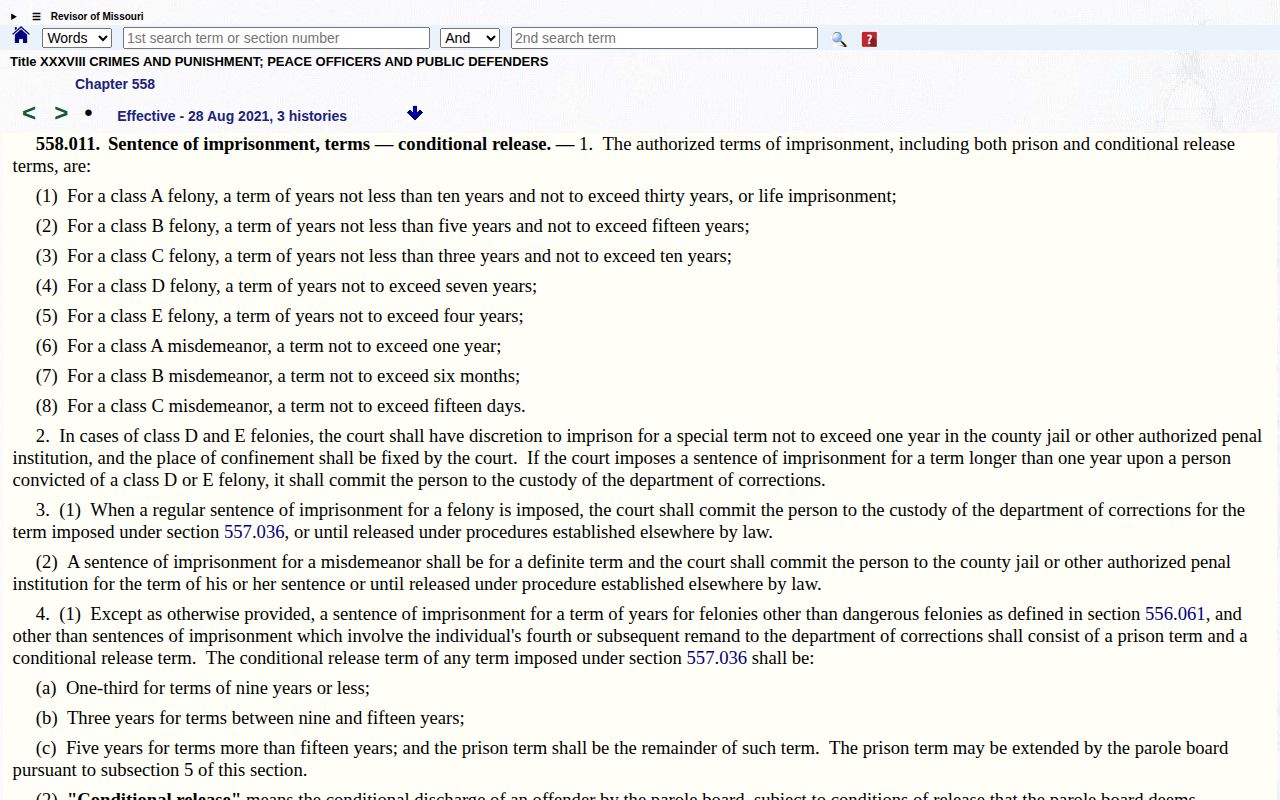
The statute supplies the legal proportions and exceptions that must be read with the judgment. It does not display an individual’s current release calculation.
Note: Statutory conditional-release proportions provide a framework, not a guaranteed physical exit date for a named person.
When Monroe County’s 85% Rule Applies
Missouri’s 85-percent rule is not universal. RSMo § 558.019 requires a person committed to MODOC for a “dangerous felony,” as defined by § 556.061, to serve a minimum prison term of 85 percent of the court-imposed sentence, or until age seventy after serving at least forty percent, whichever occurs first. The minimum prison term controls eligibility for parole, conditional release, or another early MODOC release.
Other minimum-term rules may apply because of the offense or prior prison commitments. A reliable calculation requires the judgment, offense classification, applicable version of the statutes, MODOC sentence record, and any Board decision. It is inaccurate to multiply every sentence by .85.
The current dangerous-felony minimum-term statute should be checked directly.
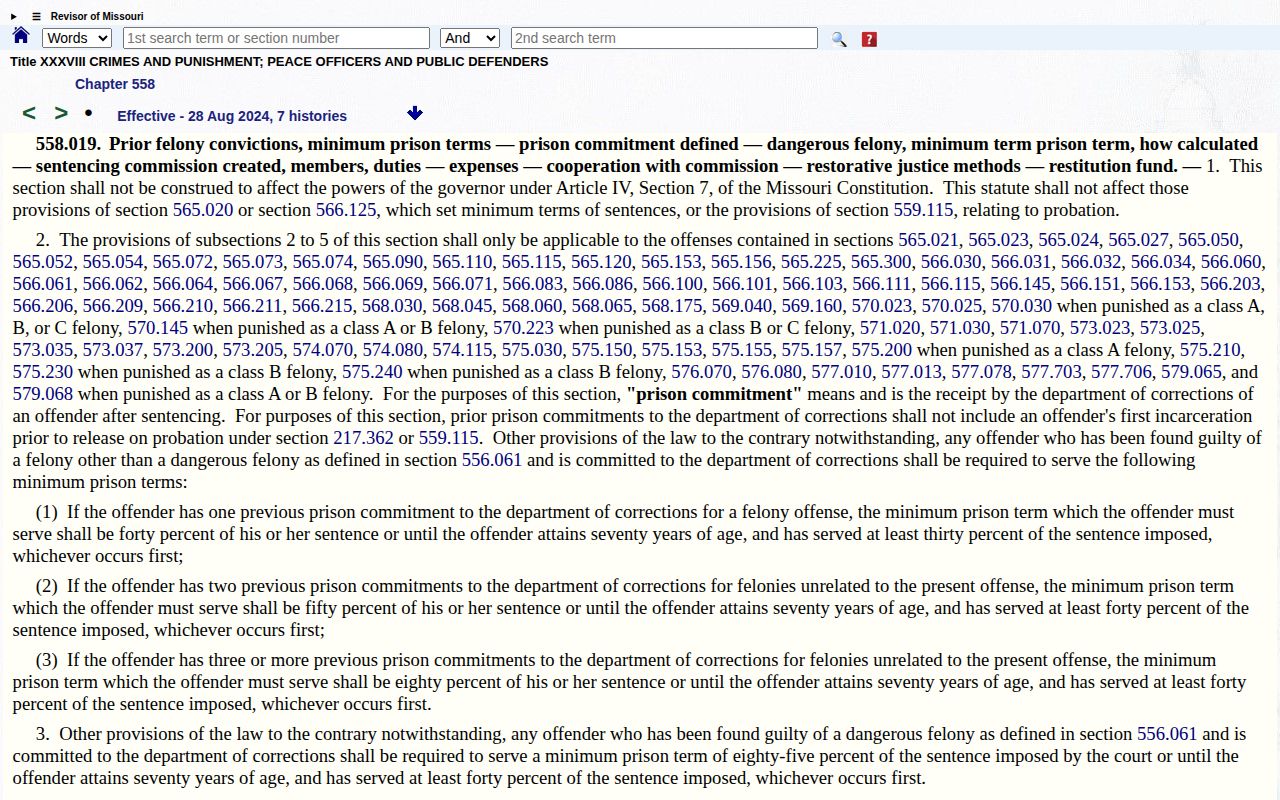
The statutory text demonstrates why the offense classification is essential before discussing a percentage.
Why Monroe County Release Dates Change
A projected date can move when the legal sentence, sentence credit, correctional record, Board action, conduct, program status, or another custody claim changes. The source record should identify which factor controls.
| Factor | Effect on the date |
|---|---|
| Credit correction | Verified jail or sentence credit may be added, removed, or recalculated. |
| Concurrent or consecutive terms | The controlling sentence relationship can change the computation. |
| Detainer or another sentence | Another agency or sentence may become controlling even when one custody term ends. |
| Parole Board action | The Board may grant, deny, defer, rescind, or change a presumptive date. |
| Conduct and release plan | A tentative date can depend on institutional behavior and an acceptable plan. |
| Required program | Failure to complete an applicable program can move a conditional-release date. |
| Revocation | Parole or conditional-release revocation can return the person to custody and cause recalculation. |
| Court action | A modified or vacated judgment changes the legal basis for the calculation. |
MODOC Victim Services specifically notes that failure to complete the Missouri Sex Offender Program can affect a conditional-release date for an applicable offender. That fact should not be generalized to people for whom the program does not apply.
Note: A changed date should be traced to the sentence, court, Board, program, conduct, credit, or detainer record that caused it.
Find Discharged Monroe County Dates
Missouri’s ordinary MODOC name search is active-only, but the nightly Sunshine file contains current and prior offender data. Its file documentation defines the minimum release field $PC, maximum release field $PD, and completed-sentence field $SCF. This makes the historical file a useful technical path for a fully discharged person who cannot appear in the ordinary active search.
The MODOC Sunshine page provides the nightly file and layout information.
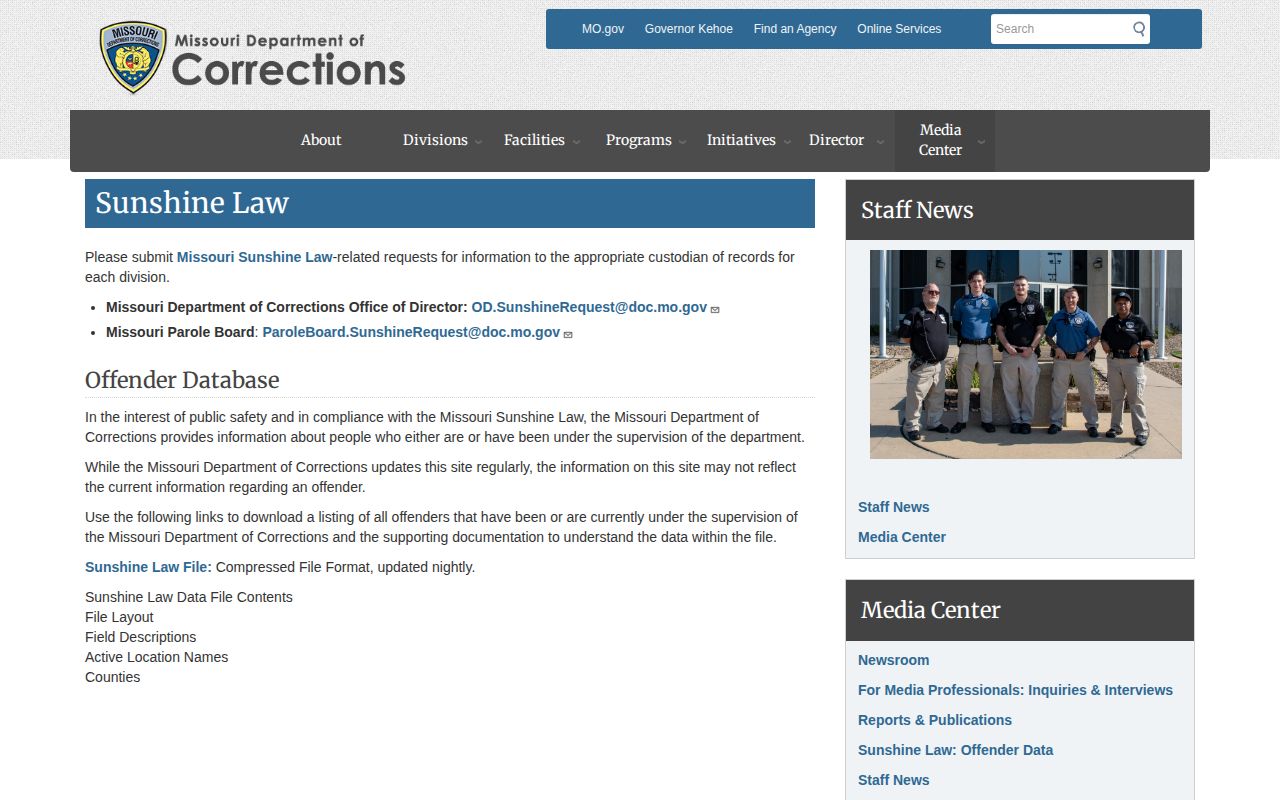
The file is bulk data rather than a simple consumer name lookup. Match on DOC ID and identifiers, interpret the labeled fields, and corroborate an ambiguous record with MODOC or Case.net. MODOC notes historical data dating as early as 1974 but also warns about conversion and self-reported-data limitations.
Parole Dates for Monroe County Sentences
RSMo § 217.690 authorizes the Missouri Parole Board to adopt eligibility and hearing rules. The Board’s Blue Book and appendices provide time-to-serve guidance, but the agency states that guidelines do not guarantee release. A hearing may lead to a future release date or another hearing instead.
A presumptive parole release date remains tentative. It depends on continuing appropriate institutional behavior and an acceptable release plan. A Board grant can be followed by conditions, deferral, rescission, or another action supported by the case record. Obtain the current Board or MODOC record rather than treating an old date as fixed.
Confirm a Monroe County Release Date
For a county booking, ask the Monroe County Sheriff for the actual release date and time, release type, authority, destination, and receiving agency. Sheriff Joe Colston’s office is at 300 North Main Street, Paris, Missouri 65275, telephone 660-327-4060. The Circuit Clerk at the same courthouse controls the court judgment and docket, not the jail movement record.
For MODOC, retain the DOC ID and exact field label. A targeted Sunshine request can ask for actual release type and date, supervision start or end, discharge date, and sentence identifiers. MOVANS can provide a pending custody-change alert, but the alert should be verified with the agency record. A projected date remains subject to change until the actual event is recorded.
Note: Preserve the DOC ID and exact date label so a minimum or presumptive date is not mistaken for actual release.
Request Monroe County Release Dates
A written request to the sheriff should identify the booking episode rather than asking staff to calculate a new date. Give the full name, approximate booking or release range, case number, and booking number when known. Ask for existing records that show booking date and time, actual release date and time, release type or reason, release authority, destination, and receiving agency. That wording separates a community release from a transfer.
Missouri’s Sunshine Law requires a request to be acted on as soon as possible and no later than the end of the third business day after receipt. Reasonable production can take longer, but the custodian must explain the delay and provide the earliest date and time for access. Section 610.026 permits specified duplication and staff charges. No Monroe County release-record fee schedule was verified, so ask for electronic delivery and an estimate before chargeable work begins.
If no charge was filed within thirty days after an arrest, § 610.100 can close the arrest report while leaving the disposition portion accessible. Ask specifically for the open disposition showing when and how custody ended. A closed report, expungement, or other confidentiality rule may limit details, but it should not be replaced with a guessed release date.
Monroe County Parole Date Limits
The Missouri Parole Board does not publish a named monthly hearing calendar or a person-by-person public decisions database in the official sources reviewed. A case-specific hearing date can come through authorized notification, the active offender channel, Board Operations, or Victim Services. A decision generally takes about eight to twelve weeks after a hearing, according to official guidance, but that estimate is not a legal deadline.
Possible actions include a parole grant with a presumptive date, denial with later reconsideration, deferral, cancellation of an earlier date, or conditions tied to an acceptable release plan. The exact decision letter controls. Eligibility, a scheduled hearing, and a presumptive date represent three different stages and should not be converted into an actual release date.
Dangerous-felony minimums can delay eligibility. Life-without-parole and other legally excluded sentences must not be presented as ordinarily eligible. The judgment, applicable statute, MODOC computation, and Board action must be read together for an individual record.
Match Monroe County Release Records
Before relying on any date, match the person by DOC ID, booking number, case number, and available identifying facts. Same-name results and aliases can attach a valid date to the wrong individual. Keep the source URL, access date, exact field label, and agency name. Those details allow the sheriff, Circuit Clerk, or MODOC to review a disputed calculation without confusing a county booking with a state sentence.